Located in Hood River, OR, Rahane could not be in a more beautiful place. This website features my experiences, shared with my friend Kayla, from June through August. Thank you for joining me on this journey!

Located in Hood River, OR, Rahane could not be in a more beautiful place. This website features my experiences, shared with my friend Kayla, from June through August. Thank you for joining me on this journey!

We arrived at Rahane after traveling 3,500 miles! The date was Friday, June 15th. Our timing was ideal, as we were able to settle-in over the weekend, without having to jump directly into work.
Because all buildings were currently occupied, our home for the next two months would be our well-traveled tent. We were prepared for this and looked forward to living close to nature. Having camped for many nights on our roadtrip thus far, we were experts at camp set-up.
We chose the “cathedral grove” site to put our tent down. Secluded from the rest of the farm, we were often awoken by deer crashing through our site and even by some coyotes howling. I’ll admit that some nights were tense, but most were extremely relaxing. We were blessed with only a few nights of rain so we frequently enjoyed the night stars and forest sounds with the tent’s rain tarp off.

Rahane is an interesting place. For starters, the 6 full-time employees live on the land. Dan and Aera are partners and own the land. Aera spends most of her time in the field advising and working. Dan takes care of the chickens and cherry trees, as well as general maintenance around the farm. Ari works closely with Aera in the gardens and runs the CSA (Community-Supported Agriculture) program. Adam is a leather worker and directs the construction of new, sustainable buildings and also takes care of the goats. Hunter is the lead permaculturalist and does a lot of research and development on his section of land. Nicole is a florist and runs her own garden.
The total plot is 80 acres, with 4 acres reserved for farming. Each dwelling has its own garden space, cared for by the resident. The entire farm is irrigated by a natural spring that travels downhill about a mile to the farm. As it travels, the tumbling flow highly oxygenates and purifies the water. Additionally, this source is used for hydroelectric power on the farm. This source of energy, combined with solar energy, power the entire farm with no additional inputs.


Okay, this one was a new one for me. Our first day brought us all around the farm, introducing the most important areas. Of course, the bathroom was on this list. The bathroom was an open-air structure with two toilets; one for pee and one for poop. It was recommended, however, that if you only have to go pee to just go in the woods somewhere and try not to use the same place often.
To keep the smell down, after you’ve done your business, add a handful of sawdust. The sawdust absorbs moisture and smells, important for keeping flies away. I ended up enjoying this system. It was nice to do what you need in the presence of nature, knowing you’re taking care of your waste sustainably. Some nights were pretty cold, but it was easy to get used to.
The system uses aerobic composting to process the waste into fertilizer. Adding sawdust not only helps the smell, but also creates pockets of oxygen in the mix, facilitating aerobic composition. Bacteria and fungi are responsible for breaking down the waste. The fertilizer cannot be used for growing crops, but it is used for adding nutrients to the lower fields. These fields grow whatever native seeds find their way into the area.
Twice a year, the waste is removed from the outhouse and moved to a secondary composting area. Straw is added to increase oxygen levels, and the pile now goes through a mesophilic composting process. As chemical reactions breakdown the mix, heat is released creating an environment fluctuating from 70°-113°F. In this environment, mesophilic organisms such as fungi and bacteria thrive. Prolonging this step ensures any pathogens are killed by the mesophiles.
The end product is a humus-like substrate that is very rich in nutrients.

Bill Mollison
“Permaculture is a philosophy of working with, rather than against nature; of protracted and thoughtful observation rather than protracted and thoughtless action; of looking at systems in all their functions rather than asking only one yield of them…”
At its core, the goal of permaculture is to create a way of life that is in perfect harmony with nature. Permaculture systems mimic the patterns and relationships found in nature to yield an abundance of food, fiber and energy for local needs. Living this way allows the land to be used perpetually. Permaculture takes planning and time to become successful. Eventually, a successful permaculture operation will mature into a closed-loop system, meaning it can sustain itself without any off-site inputs.
A simplified outline of such a system is as follows. Rich, living soils feed the crops. These crops feed the people. Composted waste and cover crops feed the soil, and the cycle repeats.
Rahane is a successful, mature permaculture system. All residents are fed by the land with enough abundance to sell produce at local farmer markets. All of this is achieved without any off-site inputs.
Additionally, many of the buildings on the farm are sustainably built. An example of such are the greenhouses. They are built from a wood frame that is wrapped in chicken wire. A layer of straw and mud is applied to the frame in successive layers to create the walls. As the walls deteriorate, new layers of this medium are applied. This construction provides great insulation and helps to extend the growing season.

Typically, Rahane likes to have their corn in the ground by the start of June. However, due to previous heavy rains, there was still a lot of planting to do. Because of this, our first week (and then some) was spent planting corn. Right away, I noticed many differences in planting methods from the traditional ones I was used to.
Rahane does not use any machines in planting and also practices a technique known as “no-till”. This method does not disturb the layers of soil which creates an environment where soil microbes can thrive, and also increases water penetration and absorption.
The first step was to sprinkle a thin layer of compost over the soil. The compost came from Rahane’s composting site. We prepared rows by using a digging fork to loosen the soil, taking care not to turn the soil over. The technique was “fork and twist”. This was physically demanding and a great workout.
After the soil was loose, we planted the corn. Seeds were spaced at about 12″ and were simply pushed into the soil to finger-depth. I wish we were able to stay on the farm long enough to try some of this corn because the kernels were beautiful! Hues of pink, purple, brown, and amber denoted unique varieties we planted.


My previous farming experience has been on farms that till their fields extensively. At those farms, fields are disked, harrowed, and then plowed before planting. This involves a lot of heavy machinery. I learned this is not a good farming practice for many reasons. The most obvious (in hindsight) is the sheer weight of those machines tracking over the land compacts the soil. After only a few years of this farming practice the soil at depths of only 6-12″ becomes hard as a rock. This layer is referred to as the “plow pan”. This reduces the water holding capacity of the soil and roots have difficulty penetrating. Because the soil is so dense, water cannot penetrate into deeper horizon layers and runs off as sub-surface flow. This flow carries much of the loosened layer of top soil with it, further decreasing the total amount of soil available to the plants. Also, because of the decrease in penetration, the soil will dry out faster, causing farmers to irrigate more often.
Additionally, turning the soil over in this aggressive fashion hinders the function of soil microbes. Soil microbes are an incredibly diverse group of organisms, each with its own function and specific soil depth where these functions take place. Eventually, the soil will not support these microbes and becomes sterile.
Without these microbes functioning, the soil loses its ability to recycle nutrients and create soil aggregates. In this situation, to produce crops, farmers have to add synthetic fertilizers to the soil. Because the soil is compacted with low water penetration, a lot of these added fertilizers are washed away when irrigated. They end up in our waterways, causing further problems.
Additionally, without the microbes exuding polysaccharides, glomalin, organic acids, and amino acids, there is no “glue” to hold soil particles together and create soil aggregates. Normally, soil aggregates provide pore space that functions to increase water penetration and allows oxygen into the root zone. Without them, soil porosity is decreased, further decreasing water penetration while increasing run-off even more.

After my experiences at Rahane, I view weeds from a different perspective. I learned that so-called “weeds” can actually benefit a garden. When weeds are used to enhance an agricultural space, it is called “cover crop planting.”
There are many plants on Earth that can enhance soil health. In traditional agriculture, they are not planted because they have no direct value as harvested crops, but their benefits cannot be overlooked. Cover crops can be used to add nutrients to the soil, maintain soil health during off seasons, and increase water penetration levels. Rahane takes advantage of these components in their intentional planting of cover crops throughout the year.
The function of legume producing plants as nitrogen fixers is well known. They are able to add nitrogen to the soil through forming symbiotic relationships with bacteria called rhizobia. The plant roots excrete flavonoids that attract the bacteria. The bacteria then grows into the plant root, creating a visible “ball”, called a nodule. In exchange for sugars from the plant, the bacteria fixes nitrogen into a form the plant can utilize. When the plant dies, this allocation of nitrogen is released into the soil and becomes available to other plants. Because of this relationship, Rahane plants hairy vetch and red clover as nitrogen fixers during crop rotation years.
In addition to enhancing soil nutrients, cover crops also protect soil from direct sunlight. Direct sunlight will dry out the soil and increase temperatures. Both these factors inhibit soil microbial growth. By shading the soil, soil conditions are maintained throughout the year, allowing soil flora to flourish, increasing the overall health of the soil. By keeping these microbes thriving, as previously mentioned, water penetration levels will increase due to increasing soil aggregation.
An added bonus of cover crop is the simple fact that they flower. This attracts pollinators to the garden that are vital to the success of any agricultural endeavor.
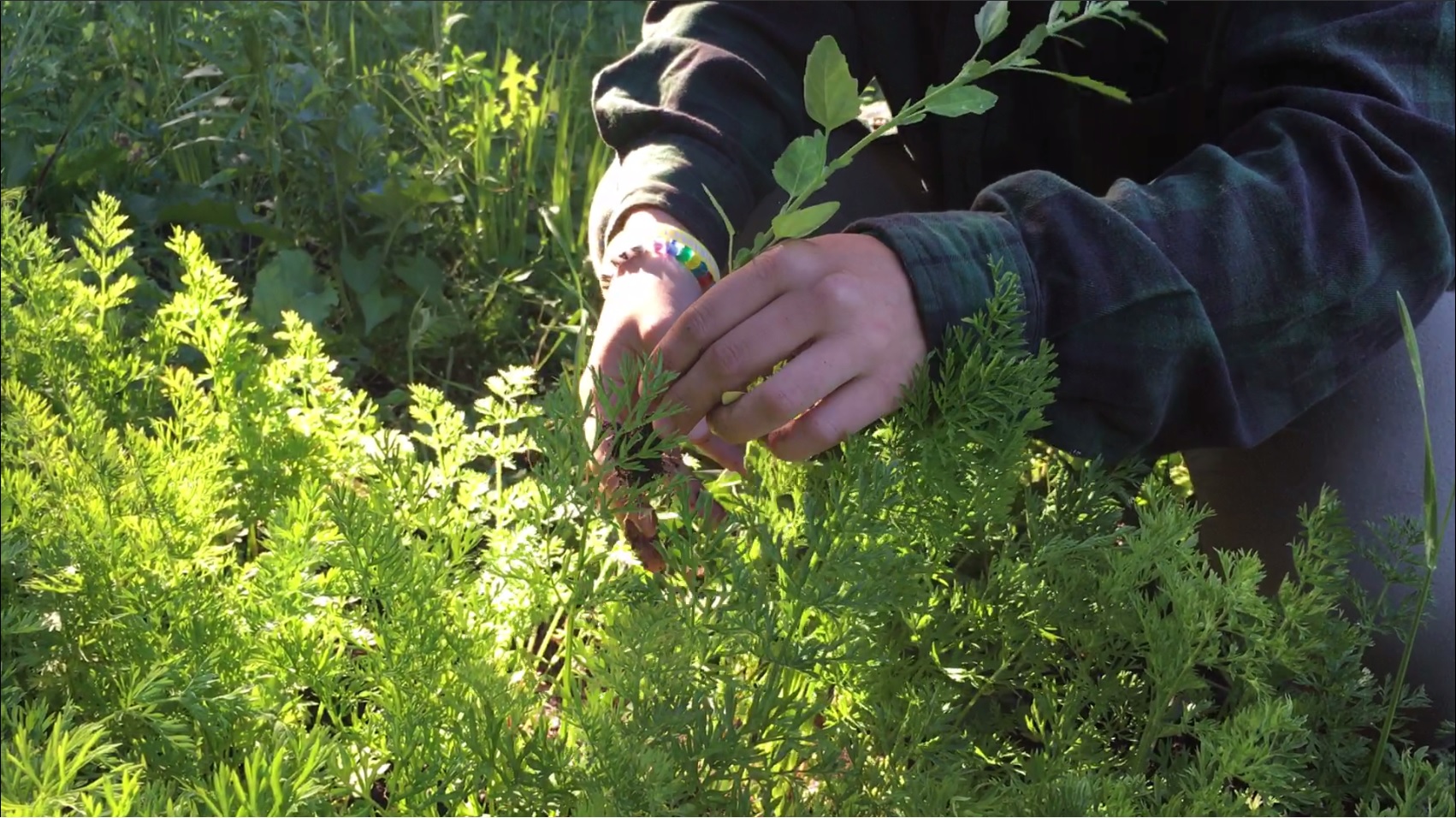
With nature’s amazing breakthroughs in seed dispersal, weeding is a daily task of any garden. Inevitably, undesirable plants will begin to take root in your garden and compete with your crops for nutrients. However, if you know how to deal with them, they can help your garden.
Weeding was certainly a daily task for us at Rahane Farm, and sometimes, it was the whole day. Through many hours of weeding, we learned techniques to increase soil health.
To begin, when pulling out a weed, it is important to disturb the soil as little as possible. You don’t want to displace any of those microbes from their homes, and you also don’t want to lose any of that precious soil. So, it is proper technique to place two fingers around the base of the weed, as you pull it out with your other hand, so no soil is removed from the bed. This technique works best with small weeds that have not yet developed fully. This makes pulling them easy due to their limited root mass.
Once the weed is removed, place it in the row between beds. This allows the weed to decompose and add its nutrients back into the soil. When many weeds are placed in this fashion (they add up quick!) they create habitat and food for detritivores like pill bugs.
When weeding especially abundant areas, excess weeds were added to our compost pile where they will decompose more efficiently.

Soon after our arrival, the strawberries were ripe! I had been looking forward to this day since I saw the patch. My first agricultural job found me picking strawberries at Zentek farms four years ago, and I’ve been picking them ever since! Those Zentek berries were my first farm-fresh experience and they blew the store bought varieties out of the water. Don’t tell any of the Zenteks, but Rahane’s berries were even better.
The abundance of berries was what I was used to and, though they were smaller, they were much sweeter. I think the amazing taste resulted from the way they were grown. These berries were 100% organic, non-GMO and grown in a living soil. To be honest, sometimes I got lost while staring at one in the sun, observing the tiny specks of varying hues of red, each glittering like a gem. They were beautiful!
An interesting note: the patch had not been weeded and there were some HUGE weeds in there. The interesting part is that it did not seem to affect yields at all. Perhaps strawberries benefit from partial shade.
We picked this patch every-other-day for about a month. The best berries were saved for CSA orders. Second best were enjoyed by us farmers and some were turned into jam.
During this same period, we also harvested tons of black and red currants. The raw black currants tasted really earthy and I did not enjoy them. The red ones, however, were delicious! Regardless, we turned both into jam.
We also harvested gooseberries, which was a new species for me. I would compare them texturally to muscadine grapes, with a taste like wild blueberries. The plants have HUGE thorns on them and we all were poked and stabbed many times. Kayla still might have a thorn in her hand to this day.

 Rahane Farm